What Are the Biggest Test Automation Challenges in 2026?
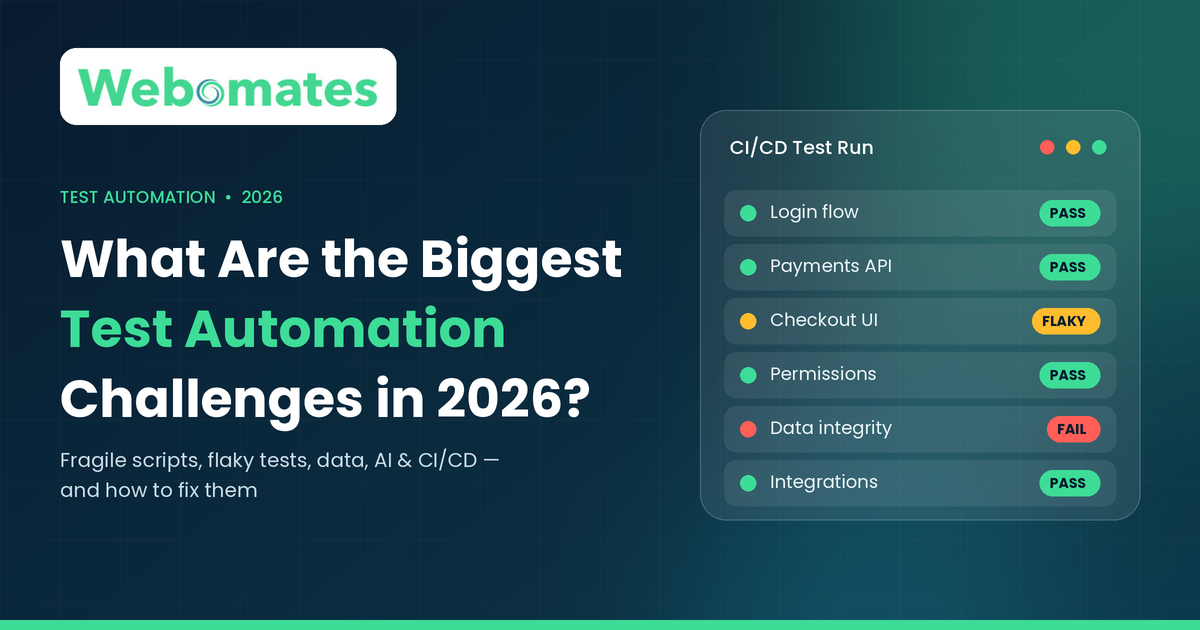
Software teams must release faster while supporting more devices, integrations, and user journeys. Automation helps, but scripts alone do not guarantee reliable releases. In 2026, Test automation challenges include maintaining changing tests, managing trustworthy data, and making results useful in delivery pipelines.
Fragile Scripts and Constant Maintenance
Applications change frequently: buttons move, APIs evolve, and workflows gain steps. Tests using brittle selectors or fixed timing can fail even when the product works. Engineers then repair scripts instead of investigating defects, making Test automation challenges expensive after each release.
Use stable test IDs, reusable page or service objects, explicit waits, and clear assertions. Focus on critical journeys and investigate failures before changing scripts. AI-assisted maintenance may help, but verify proposed updates.
Unreliable Test Data and Environments
A test can fail because an account, database record, permission, or service is missing. Production-like data may be restricted for privacy, while small datasets miss edge cases. The World Quality Report 2025–26 identifies secure, scalable test data as a major obstacle.These Test automation challenges require data practices, not just better scripts.
Create predictable data through fixtures, APIs, or controlled generation. Reset state between runs, document dependencies, and use synthetic or anonymized data when suitable. Monitor environments to separate product defects from configuration problems.
Flaky Tests and Slow Feedback
Intermittent failures damage trust: a test may pass locally, fail in a pipeline, then pass again without code changes. Network delays, asynchronous behavior, shared state, and unstable environments can contribute. Repeated reruns slow delivery and hide genuine defects. Test automation challenges often persist until the underlying cause is fixed.
Track flaky tests as a quality issue. Capture logs, screenshots, and traces; isolate shared data; and diagnose causes before increasing timeouts. Run fast checks on every change and broader regression suites at suitable pipeline stages. Reliable feedback matters more than test volume.
Using AI Without Validating Its Output
Generative AI can draft tests, suggest assertions, and summarize failures. However, scripts may misunderstand requirements, miss edge cases, or test implementation details instead of user expectations. The World Quality Report 2025–26 found that many organizations are experimenting with GenAI, while far fewer have scaled it enterprise-wide; integration, data security, and reliability remain concerns.
Treat AI output as a starting point. Validate test logic against requirements, negative paths, and business rules. Set guidelines for sensitive data, approved tools, human review, and measuring value. AI should support engineering judgment, not replace it.
Connecting Automation to CI/CD and Existing Tools
Automation has limited value when tests run separately from code review and release decisions. Disconnected reports, duplicate cases, and manual handoffs obscure which failures should block a release. These Test automation challenges grow across APIs, services, browsers, and environments.
Integrate tests with version control and CI/CD, publish shared results, and define pass, fail, and retry rules. Match each test layer to the feedback speed it can provide, and review tool overlap to keep the toolchain manageable.
Skills Gaps and Unclear Ownership
Automation requires product knowledge, test design, debugging, and risk assessment—not just coding. When developers, testers, and operations work in silos, scripts become hard to maintain and issues surface late. Solving Test automation challenges also means clarifying ownership of test creation, data, pipeline health, and releases.
Pair QA engineers with developers during planning, document critical tests, and train teams on the framework and product behavior. Shared responsibility helps automation remain useful as priorities change.
Measuring Coverage Instead of Meaningful Risk
A large suite can create false confidence if it repeats happy paths and misses key journeys. Coverage alone does not show a defect’s impact or the cost of a broken workflow. Prioritize login, payments, permissions, data integrity, and critical integrations by business risk.
Track escaped defects, failure causes, suite duration, flakiness, and maintenance effort alongside coverage. Fixing Test automation challenges does not always mean adding scripts; removing redundant tests and improving meaningful checks may work better.
Build a Sustainable Test Automation Strategy
Identify slow or unreliable tests, map them to customer risks, and choose measurable improvements. Establish ownership, protect data, make failures diagnosable, and integrate results into development. Expand gradually, ensuring each new test provides useful feedback without excessive maintenance.
Before scaling a suite, review results with product owners and engineers. Retire tests that no longer protect active functionality, and keep a short record of decisions so future maintainers understand why each check exists before scaling the process further.
In 2026, Test automation challenges are best addressed through stable practices, credible data, selective AI adoption, and QA-development collaboration. Measure progress by trustworthy decisions, not test count alone. Webomates can be part of the evaluation as teams improve test visibility and automation workflows.